NatusAI
Relationships
Customers, equipment, contracts and events linked directly, so ownership, dependencies and causes are easy to follow.
 Connected data foundation · Layer 01 · Connected foundationPlanned v1
Cygnus is the planned data foundation of the NatusAI platform. It keeps assets, documents, locations, measurements and their relationships together, so people and approved AI assistants can answer questions that used to take days.
Planned v1 scope & 25 acceptance gates →Roadmap: later profiles →

A sensor reading has a time, a place, an asset and a source. A contract refers to the same asset. Cygnus keeps these connections, so answers follow them instead of rebuilding them each time.
Customers, equipment, contracts and events linked directly, so ownership, dependencies and causes are easy to follow.
Who operates what, which report describes which incident: facts tied to the things they describe.
Positions, tracks and areas linked to the assets they belong to, and to their history.
Readings kept beside the assets they describe, from one moment to years of history.
Find information by what it says, then follow it back to the original source.
Names, identifiers and passages, combined with relationships, place and time.


A vessel entered a storm area at 14:00. A corrected position arrived at 14:10. Cygnus is designed to reconstruct the 14:05 decision with what was known at the time, or to show the corrected picture. That is the history an auditor or supervisor asks for.
Cygnus is planned to combine its own typed programming language with storage, execution and services. Business logic works with persistent entities and their relationships directly, reducing the translation between database rows, application objects and API responses.
The same typed model carries data from durable storage into application logic and service contracts. Fewer mappings mean fewer places for types, field names and relationship definitions to drift.
Start from an indexed entry point, follow the relationships you need and constrain by time, space or search. The optimised query model aims to do that work close to storage and return only the requested result.
Typed functions become application services and authorised tools. HTTP/RPC, streaming, generated TypeScript clients and MCP descriptors are part of the backend design, reducing separate adapter layers to maintain.
A large graph does not need to be loaded into memory in full. Persistent references let an operation resolve relevant nodes, index pages and time ranges as they are needed.
Looking at one vessel should not require loading every vessel, every document and the entire position history. Selective traversal and bounded reads are designed to keep memory use tied to the work being performed.
That is the route to faster connected queries and lower resource overhead: less materialisation, fewer transfers between services and less duplicated context. Actual gains depend on the graph, indexes, workload and hardware.
Illustrative access path
01 / Durable graph
Vessel · Cargo · Route · other vessels · other cargo · older ranges stay on disk.
Only references and an indexed selection are touched at first.
02 / Relevant working set
Selected vessel → cargo → requested track
Resolve the connected data and time window this operation uses.
03 / Bounded result
Page · sample · stream
Return a page, sample or stream. Large exports and rebuilds use bounded processing or durable jobs.
Relational systems work well for structured records and SQL reporting. As a connected application adds history, maps, semantic retrieval and AI, the cost often shifts toward joins, object mapping and coordinating extra services. Cygnus is designed to reduce that overhead inside one programmable engine.
| Dimension | Tabular storage + application stack | Cygnus unified temporal graph (planned) |
|---|---|---|
| Data storage | Entities become rows; relationships use keys and often linking tables. Application code maps rows into objects. | Typed entities and persistent links share one model across storage, logic and services. |
| Connected queries | Joins reconstruct relationships at query time. Deep paths can add query and mapping complexity. | Indexed entry points and graph traversal follow stored relationships, with temporal and spatial constraints. |
| Memory & data movement | Efficient engines already use indexes and caches; broad joins and application-side processing can still create large intermediate results. | Resolve graph data on demand; use bounded ranges, pages and streams rather than materialising the entire connected dataset. |
| History & corrections | History tables, temporal extensions or event models must be designed and aligned with application queries. | Temporal state and bitemporal access belong to the model, preserving the distinction between valid time and knowledge time. |
| Geo, text & vectors | Extensions can add capabilities in one database; specialist services may need their own identity, indexing and synchronisation paths. | Spatial, time-series, text and vector resources connect to the same entities and versioned sources. |
| Query & application languages | SQL plus application code, mapping libraries and sometimes separate search or graph query languages. | One native typed language and optimised query model bring computation close to persistent graph structures. |
| Maintenance & evolution | Coordinate database schemas, mappings, service contracts and any separately operated retrieval stores. | Shared type descriptors and service contracts reduce duplicated definitions; migrations and index changes follow explicit version behaviour. |
| AI & access control | Typically add a tool gateway and chat layer, then align their permissions with the data paths they call. | Native MCP and a bounded chat contract use the same typed services, with authorisation in storage and execution paths. |
How to measure it: the intended advantage is faster relationship-heavy work with less mapping, synchronisation and resource overhead. Measure query latency, peak memory, disk I/O, ingest and maintenance effort on the same workload and hardware. A warehouse or mature SQL stack may remain the better fit for large tabular analytics or required extensions.
An AI answer becomes more useful when it can connect the right document to the right entity, location and moment. Cygnus is planned to bring retrieval, callable business logic and conversation records into the backend model.
Model Context Protocol gives authorised agents a discoverable, typed way to use backend functions. Tool discovery and execution follow the caller’s permissions, with the same service contracts used by applications.
The planned provider-neutral chat contract covers messages, streaming events, tool calls, structured output and durable session/run records. Local or remote model bindings are selected and qualified explicitly for the deployment.
Combine full-text and vector retrieval with graph, spatial and historical context. Keep references to source versions and the chosen time context so a person can inspect the evidence and understand how an answer was formed.
Data-access rules apply before disclosure and search ranking. Retrieved content and model output do not grant permission to act; protected actions require their own authority and, where specified, a human decision.
“Which cargo was on vessels inside the storm area yesterday, and which reports explain the risk?”
This proposed maritime workload brings the architecture together. The same approach can connect equipment, telemetry and maintenance in energy, manufacturing or infrastructure applications.

How the answer is built
Select yesterday’s interval and whether the question uses what was known then or later corrected evidence.
Use geospatial selection and time-series ranges to identify vessels whose tracks intersected the storm area.
Traverse the vessel’s historical relationships to cargo, operators and ports, resolving the required parts of the graph.
Combine keyword and semantic search over authorised document versions, linked to the selected entities and time context.
A typed service or MCP tool returns the evidence. Chat can explain it while retaining the sources and relevant context.
We separate what is proven from what is coming, and label both. NatusAI Cygnus is planned for its first release (v1).
Cygnus holds the data and the business logic. NatusAI Lyra shows it, NatusAI Auriga and Aquila let AI work with it, NatusAI Orion builds applications on it, NatusAI Draco runs it and NatusAI Gemini recovers it.
What Cygnus is. A planned programmable temporal graph database: its own typed language, an optimised query model and a backend runtime. Graph, geospatial, vector, triple-store semantics, time series and full-text search share one model, with one identity, one transaction model and one authorisation boundary.
| Profile | First release | Boundary |
|---|---|---|
| Embedded | Included | One application process with local storage. |
| Development | Included | Empty-project bootstrap and explicit source modes. |
| Production, single server | Included | One node; backup, point-in-time recovery and verified restore in scope. |
| Cluster | Excluded | No sharding, replication, distributed traversal or failover claim. |
| Isolated workload | Excluded | No separately qualified isolated-workload profile. |
| Gate | Proposed threshold | Status |
|---|---|---|
| Production design partners on the reference workload | At least 3 | Not yet passed |
| Production system of record with retained history | At least 1, with 6+ months of history | Not yet passed |
| Sustained position ingest, 32-vCPU reference class | ≥ 100,000 reports/s | Not yet passed |
| Vessels inside a polygon over 250,000 live positions | p99 ≤ 150 ms | Not yet passed |
| Hybrid top-20 retrieval over 5 million documents | p99 ≤ 300 ms | Not yet passed |
| Out-of-core correctness | Dataset ≥ 24 × RAM | Not yet passed |
| Element-level authorisation overhead | ≤ 2 × coarse-grained policy | Not yet passed |
| Acknowledged commits lost on one server | Zero | Not yet passed |
| Scheduled verified-restore drills | 100% pass | Not yet passed |
| Agent-driven empty-project evaluations without human repair | ≥ 70% succeed | Not yet passed |
Runs on your servers as one system, with no separate search, graph and time-series services to license and secure.
Answers keep references to the source version and the moment in time they used.
Data-access rules apply before anything is shown or ranked. Retrieved text never grants an AI permission to act.
Verified restore and point-in-time recovery are release requirements, not options.
The issues, approaches and useful outcomes from our industry stories and reference architectures. Each example highlights the dimensions that make the problem a fit for the planned Cygnus unified model.

01 · Banking & financial services
Accounts → Transactions → Investigation
Cygnus fitGraphTriplesTemporal historyFull-text

02 · Energy & utilities
Grid assets → Meter readings → Maintenance
Cygnus fitGraphGeospatialTime seriesTemporal history

03 · Manufacturing
Equipment → Sensor history → Intervention
Cygnus fitGraphTime seriesTemporal history
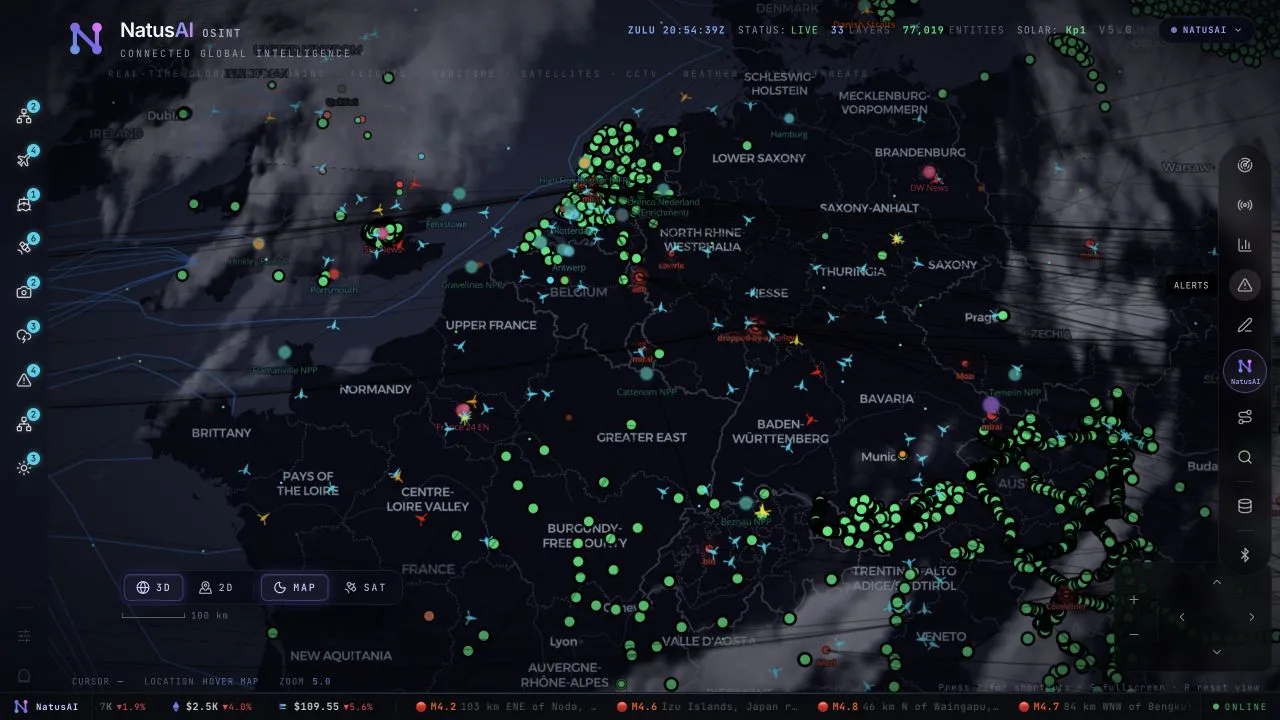
04 · OSINT
Places & events → Source reports → Assessment
Cygnus fitGeospatialGraphFull-textTemporal history

05 · Solar & infrastructure planning
Buildings → Solar conditions → Scenarios
Cygnus fitGeospatialGraphTime series

06 · Telecommunications
Customer → Service request → Human handoff
Cygnus fitGraphFull-textTemporal historyChat
07 · Trade & supply chains
Trade flows → Dependencies → Disruption
Cygnus fitGraphGeospatialTemporal historyChat
These stories describe projects, explored workflows and reference architectures. The Cygnus fit labels map them to the planned product; they do not establish a released Cygnus deployment.

A paired foundation
NatusAI Lyra provides reusable web components for maps, graphs, search and application workflows. The wider Orion and Cygnus integration is part of the platform vision. Explore NatusAI Lyra

Reusable interface components for dashboards, maps, documents and AI conversations.

Turn documents into knowledge you can cite, with the source one click away.

AI assistants and tools that work within the permissions and budgets your people set.
Short answers for decision-makers. Your technical team will find the detail in the disclosure above.
Not yet. Cygnus is planned for a first release that is accepted only after its defined acceptance tests pass. The same engine as our client projects is already proven in delivery, and our team builds on it today.
No. The first release targets one server. A worldwide data model can run on one node within its tested limits; global geography does not imply a cluster.
Not necessarily. Cygnus is designed for connected, relationship-heavy work. For large tabular reporting, a warehouse or mature SQL stack may remain the better fit, and Cygnus can sit beside it.
Bring one. We will show you how a connected model would answer it, and what it would take.
Or write to contact@natusai.com